
Mental and behavioral health billing
Mental and Behavioral Health Billing Services, Run Inside Your EHR
Fintax RCM is a mental and behavioral health billing company for therapists, psychiatrists, psychologists, substance use programs and group practices. We verify benefits, file claims, post payments and appeal denials from inside your EHR, whether that is SimplePractice, TherapyNotes or another system. Billing is 4-8% of collections, starting at 4% for basic billing. Credentialing is $150 per application, per provider. No long-term contract.
One session, from benefit check to payment
Illustrative- 1
Benefit check
Who really pays: the plan, or its behavioral health company
- 2
Session note
Shows the time and the type of session
- 3
Claim
Sent to the company that pays the therapy benefit
- 4
Follow-up
Denials appealed, short payments caught
- 5
Paid
Posted to the right client and visit
- Billing
- 4-8%
- of collections, from 4% for basic billing
- Credentialing
- $150
- per application, per provider
- Payer approval
- 60-90 days
- usually, with each payer
- Contract
- None
- leave with 60 days' notice
Find the page for your practice
Mental health billing is not one job. Each page covers what is different for that kind of practice.
- Therapists in private practiceFor LCSWs, LPCs, LMFTs and psychologists billing therapy sessions.
- Psychiatry and PMHNPsMedication visits, evaluations and therapy in the same visit.
- Psychology and testingSessions plus testing that needs approval before it starts.
- Substance use treatmentOutpatient to residential, with the authorizations each level needs.
- Groups, agencies and clinicsMany clinicians and license types under one billing team.
- Getting credentialedGetting each clinician on the right panels before they see clients.
More practice types
Where mental health practices lose insurance money
Few of these show up as a big denial. They show up as claims that pay less, pay late or never pay.
The claim goes to the wrong company
Many plans hand the mental health benefit to a separate behavioral health company. A claim sent to the name on the card comes back denied, weeks later.
Sessions paid as shorter ones
Therapy pay depends on how long the session lasted. A note without the start and end time gets paid as a shorter visit.
Prescriber visits billed like therapy
A psychiatric visit is a medical visit first. When it is billed the way therapy is, the practice is often paid for only one of the two services.
Telehealth denied on a detail
Video and phone visits follow rules that differ by payer and by state. One wrong detail turns a session you delivered into a denial.
Clinicians working before approval
A new clinician who sees clients before each payer approves them builds a schedule the insurer may not pay for.
Authorizations and visit limits
Some plans approve a set number of visits or a level of care. Go past it without a new approval and the extra sessions are unpaid.
What we handle, and what you keep
Fintax RCM runs
- Benefit checks, including which company pays the mental health benefit
- Claims sent once notes are signed, for every license type in the practice
- Prior authorizations and visit limits tracked per client
- Payments posted and underpayments flagged
- Denials worked and appealed, oldest deadlines first
- Credentialing for new clinicians, if you want it
Your practice keeps
- Treatment decisions and documentation
- Your own software, schedule and client communication
- What you charge, and how you handle self-pay
- The insurers you choose to work with
What we bill, by type of care
Each kind of visit is paid on different terms. These are the details payers look for.
- 01
Individual, family and group therapy
- What the payer looks for
- How long the session ran and who was in the room
- Where it often goes wrong
- Sessions paid as shorter ones, or the wrong session type
- 02
Psychiatric visits and medication management
- What the payer looks for
- The medical work of the visit, documented on its own
- Where it often goes wrong
- Therapy in the same visit left unbilled
- 03
Crisis care
- What the payer looks for
- Why the visit was urgent, and how long it lasted
- Where it often goes wrong
- Never billed, or denied for missing detail
- 04
Telehealth, video or phone
- What the payer looks for
- Each payer's current rules, and where the client was
- Where it often goes wrong
- Denied on a detail the payer changed
- 05
Psychological testing
- What the payer looks for
- Approval before testing starts, and who did which part
- Where it often goes wrong
- Testing done before the approval came back
- 06
Substance use treatment
- What the payer looks for
- The level of care and its authorization
- Where it often goes wrong
- Days or sessions past what was approved
How we start
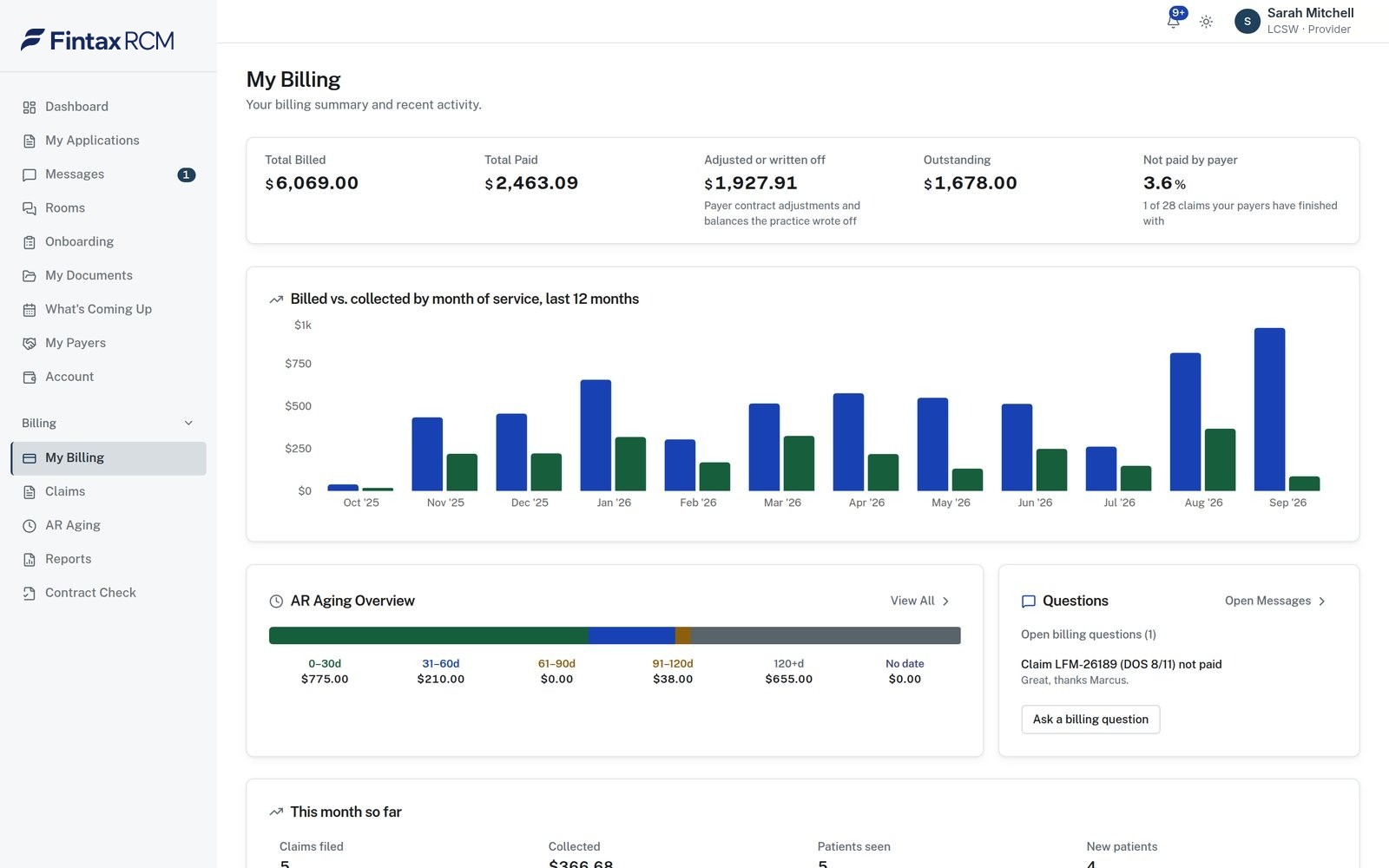
Your records stay where they are. We get a login, sort what is owed, and take over new claims.
- 01
A free consultation
We ask who in your practice bills what, and to which payers. Practices already billing insurance get a free review of some recent claims, and an exact rate.
- 02
A login, not a migration
We work from a user account in your EHR. No records are exported or moved.
- 03
Unpaid claims first
We sort what is still open by filing deadline and work the ones closest to it first.
- 04
Every license type set up
Therapists, prescribers and psychologists are billed the way each one is paid, not one way for all.
- 05
New clinicians credentialed early
Credentialing is $150 per application, per provider. Each payer usually needs 60 to 90 days, so we file as soon as an offer is signed.
Starting a practice or leaving Headway, Alma or Grow? Our guides and credentialing page are linked below.
Payer rules mental health practices need to know
Checked on CMS and federal parity pages. Plans add their own rules on top.
| Payer | What to know |
|---|---|
| Medicare | Marriage and family therapists and mental health counselors can bill Medicare since January 1, 2024, as clinical social workers already could. Medicare pays them 75% of what it pays a clinical psychologist. |
| Medicare telehealth | Mental health visits by video or phone need no in-person visit until January 1, 2028. From that date, a client who began telehealth earlier needs to be seen in person once every 12 months. |
| Medicare Advantage and Medicaid | Since January 1, 2026, these plans must answer standard prior authorization requests within 7 calendar days, urgent ones within 72 hours, and give a specific reason for any denial. |
| Commercial plans | Federal parity law says copays, visit limits and similar rules for mental health and substance use care cannot be more restrictive than for medical care, and plans must document how they compare. |
| Behavioral health companies | A plan may pass its mental health benefit to another company. That company runs credentialing and pays claims, so we find out who it is during the benefit check. |
When we are not the right fit
- A cash-only practice that will never bill insurance has little for us to do. Clients who want to claim on their own can use a superbill from you.
- Physical, occupational and speech therapy practices are billed differently. Their own pages, under therapy practices on our services page, cover them.
Questions mental health practices ask us
How much do mental health billing services cost?
Ours are 4-8% of collections. Basic billing is 4%; prior authorizations, more providers or more work raise it. Credentialing is $150 per application, per provider. Your exact rate comes out of the free consultation.
Do you bill for psychiatrists and therapists in the same practice?
Yes. We bill each the way it is paid: a prescriber's visit as a medical visit, therapy by session length. Therapy done in the same visit as medication management is billed as its own service.
Who can bill Medicare for mental health services?
Medicare lists physicians, clinical psychologists, clinical social workers, nurse practitioners, clinical nurse specialists and physician assistants. Since January 1, 2024, marriage and family therapists and mental health counselors can enroll too.
Do I have to change my EHR?
No. We bill from a user account in the system you have, including SimplePractice and TherapyNotes. Nothing about how your clinicians document changes.
How long does credentialing take?
Usually 60 to 90 days with each payer. We start as soon as a new clinician's offer is signed, so they are approved before their schedule fills.
Can I see what you are doing on my claims?
Yes. Your account manager keeps you updated on every claim, denial and payer application, and on any document we need from you.
What if I want to leave?
There is no long-term contract, only 60 days' notice. During those 60 days we keep working open claims and hand everything to whoever bills next.
Keep reading
- Billing services for therapists →
- Psychiatry billing →
- Psychology billing →
- Substance use treatment billing →
- Fintax RCM Behavioral Health, for groups and agencies →
- Credentialing for behavioral health providers →
- Telehealth billing →
- SimplePractice billing →
- TherapyNotes billing →
- Leaving Headway, Alma or Grow →
- Practice launch →
- Pricing →
+ − Sources: 6 checked 2026-10-19
- CMS, Marriage and family therapists and mental health counselors (Physician Fee Schedule), checked 2026-10-04
- CMS, Medicare & Mental Health Coverage (MLN1986542, March 2026), checked 2026-10-04
- CMS, Telehealth FAQ (updated February 26, 2026), checked 2026-10-04
- CMS, Interoperability and Prior Authorization Final Rule (CMS-0057-F) fact sheet, checked 2026-10-19
- CMS, The Mental Health Parity and Addiction Equity Act (MHPAEA), checked 2026-10-19
- U.S. Department of Labor, New Mental Health and Substance Use Disorder Parity Rules, checked 2026-10-19
Book a free consultation
We look at a sample of your actual claims and show you, line by line, where money is going uncollected. No commitment follows it.